

Please kindly note: if you are going through grief due to the loss or injury of a pet, you may find this article triggering or upsetting.
Summary:
Pets have a gentle way of anchoring us. Through warmth, companionship, empathy and the nurturing rhythm of daily care, they can make life feel softer and steadier, while helping us reconnect and integrate important parts of our inner selves that we may perhaps habitually underappreciate.
Comforting contact
What is it about pets that has such a profound impact on our mental wellbeing? Pets come in all shapes and sizes but an overwhelming majority1 of pets are furry companions – dogs, cats, rabbits, guinea pigs, etc. That poses the first question, why furry?
Well, tactile contact with soft and warm textures is relaxing and provides a soothing comfort for many of us. High street and online shops are full of fluffy rugs, throws, knitted blankets and embroidered pillows for a reason. Let’s not even begin talking about teddy bears.
Of course, many people don’t have furry pets, but perhaps ones that come with feathers, scales or shells and not all of them are intended for much handling. We’ll come back to that later.
In addition to furry, there’s warmth, coming from a real, breathing, usually cuddly companion. Just having one on your lap, by your side or even within sight, snuggled up in their bed, is enough to evoke feelings of warmth and comfort.
Active presence, mirrored states and empathy
An interesting question, is why a living, breathing pet? After all, they are quite a bit of a hassle (and cost) to look after! Indeed, it is often why many people are unable to commit to bringing a pet into their homes – and quite rightly so, as no animal should be taken into a home only to be left without a home afterwards, if this can be foreseen and avoided.
In the 90s there was an explosion of Tamagotchi “pets”, the main idea being that you could enjoy the feeling of looking after a pet, without having to pay vet bills and worry about how many hours they were left at home on their own. Well, arguably, you did have to “worry” about the hours but ultimately not quite in the same way as you would, had your Tamagochi been an organically living, breathing being.
Contact with a dog increases oxytocin levels… and decreases cortisol... Tactile contact with soothing and living beings is quite simply, how we first learned to experience love.
Contact with a dog increases oxytocin levels, associated with improved wellbeing and decreases cortisol, associated with stress2. The crux of this was known to people long before the research came to life, in simpler terms such as, being with dogs (or cats!) makes us feel good. Hence the saying about dogs being our “best friends”.
So why do they make us feel good? Tactile contact with soothing and living beings is quite simply, how we first learned to experience love. And if we were unfortunate not to have had that experience at the start of life, from an evolutionary perspective, we are wired to be receptive to that.
Textures in and of themselves have often a grounding, meditative influence because they trigger what feels instinctively safe but without having to engage our complex thinking and messy thought processes. They send messages of safety straight to our unconscious brain, activating the parasympathetic nervous system, which plays a part in our ability to ground ourselves in the moment and regulate2. This adds to the boost in oxytocin2, research showing that the same applies to contact with cats3.
But, as mentioned earlier, some pets come with feathers, scales, shells and other non-furry exteriors and often require minimal handling. So perhaps, not everyone feels safety can communicated exclusively through touch. Perhaps there is a way to gain the benefits of companionship and shared experience but at arm’s length. What if, auditory contact through bird song or simply the act of caring for and nurturing another creature is on-par with the tactile comfort for those who do like pets that can be hugged?
Then there is empathy. Many who have lived with a dog can attest that dogs “read” moods and intentions instinctively. Sure, they learn words so perhaps sometimes the connection is obvious. But how about when a family member, who may be used to hiding their pain and feelings, silently walks into the room and sits on the couch and then, within seconds, their dog is on their lap, licking their hands or just sitting with them in silence? Research4 has shown that in human-dog and human-cat3 interaction heart rate variability is mirrored.
Ever tried hugging someone with a dog around! It absolutely is a family affair, and Woof needs to be part of every hug, every kiss, every celebration and birthday cake, and often they may well learn how to dance with us too! So yes, they experience life with us, as it is, in the moment and at our level of intensity.
Love, patience and the inner child
So, a furry friend is the perfect reflection of the happy child mode5 - feeling loved, nurtured and safe to explore (those hidden treats aren’t going to discover themselves!) There is freedom of bias, there is absolutely no judgement, whether the human is in their pyjamas or a 3-piece suit, healthy or sick, able to offer 3 minutes or 3 hours, the love is and the acceptance is always there (setting aside extreme cases of abused pets which is out of scope for this discussion – although sadly, even those pets have sometimes been known to be loyal).
Having a pet enables us to find our own happy child. You know, the one we used to know, before life got serious, bills entered our brain space, and deadlines became benchmarks of success. Or perhaps, the happy child you wish you could have been, still waiting to be seen, heard and nurtured. By interacting with a pet, we facilitate regular validation for that inner child6 who still wants to play, to be loved, to have their feelings simply accepted, not judged, not rejected, not repositioned or negotiated. There is a reason why children and pets form such easy and intimate connections, without so much as a word needing to be exchanged.
…a furry friend is the perfect reflection of the happy child mode… Having a pet enables us to find our own happy child.
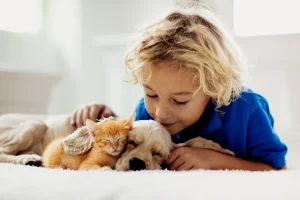 Contact with a pet allows us to temporarily revisit that life-stage where innocence was still paramount to our experience and, as we continue our lives in the hear-and-now7 re-integrate that into our present self, reuniting parts of our experience that may have been fragmented and disconnected previously8.
There’s also the element of patience. Pet care requires patience, as part of their training and as part of sharing living quarters (queue: puppy licking your face to say good morning, kitty meowing because dinner is overdue). Humans – well, we require quite a lot of patience too, don’t we? Our poor furry (or less furry) companions need to wait until we can show them attention, love and play with them. They survive our arguments and our travels and take part in our joys and sorrows.
And there-in lies an important part of the healing that pet companionship offers: the cycle of patience. A harmony of give-and-take that helps us re-learn, perhaps, that giving may often be just as or even more joyful than taking. Just watch the smile on someone’s face as they give their pet their favourite treat. Patience really is just love.
So yes, when your 5-year old announces happily that they are ready and packed for the holidays, having put only their big fluffy teddy-bear doggie into their suitcase - they really are right; they have packed all they need. The wisdom of children is that they see things in their true essence. When a young adult reflects profoundly that perhaps as humans, we only half deserve the abundance of love that pets offer, then perhaps their pet has facilitated learning through humble acceptance and gratitude, which ultimately paves the way to healing in many situations9.
Pets are love. They facilitate for us a projection of our inner child, allowing us to love that inner child again, alongside our fluffy friend. They patiently teach us how to be considerate and accepting, as they busy themselves considerately accepting us as we are. They ground us - because dinner is still dinner and is required on time, thank you, even if the stock market has gone crazy today. They are pure beings with straightforward and yet profound needs. They remind us that life grows in meaning through any real, palpable, loving and yet astoundingly simple, connection.
The Beatles said it best: All We Need Is Love. 3 woofs to that.
References
1 World Animal Foundation, UK Pet Ownership Statistics In 2026, https://worldanimalfoundation.org/advocate/pet-ownership-statistics-uk/, accessed 20 May 2026
2 Jillian T. Teo, Stuart J. Johnstone, Stephanie S. Römer, Susan J. Thomas, Psychophysiological mechanisms underlying the potential health benefits of human-dog interactions: A systematic literature review, (2022) International Journal of Psychophysiology, Volume 180, p. 27-48, ISSN 0167-8760, https://doi.org/10.1016/j.ijpsycho.2022.07.007, cited in https://www.sciencedirect.com/science/article/pii/S0167876022001787, accessed 1 June 2026
3 Nagasawa, T.; Kimura, Y.; Masuda, K.; Uchiyama, H. Effects of Interactions with Cats in Domestic Environment on the Psychological and Physiological State of Their Owners: Associations among Cortisol, Oxytocin, Heart Rate Variability, and Emotions, (2023) Animals 2023, 13, 2116. https://doi.org/10.3390/ani13132116, accessed 3 June 2026
4 Koskela, A., Törnqvist, H., Somppi, S. et al. Behavioral and emotional co-modulation during dog–owner interaction measured by heart rate variability and activity, (2024) Scientific Reports 14, 25201. https://doi.org/10.1038/s41598-024-76831-x, accessed 1 May 2026
5 Young, J. E., Klosko, J. S., Beck, A. T. (1994). Reinventing Your Life: The Breakthough Program to End Negative Behavior...and Feel Great Again. United States, Penguin Publishing Group
and
Understanding Schema – The Schema Therapy Institute, https://www.schemainstitute.co.uk/understanding-schema-therapy/, accessed 23 May 2026.
6 Bradshaw, J. (1991), Homecoming: Reclaiming and Championing Your Inner Child. London, Piatkus.
7 Polster, E. and Polster, M. (1977) ‘Gestalt Therapy’ in B.B. Wolman (ed.), International Encyclopedia of Neurology, Psychiatry, Psychoanalysis and Psychology (Vols 1-12), New York: Aesculapius
8 Shwartz, R. C. (2021), No Bad Parts – Healing Trauma & Restoring Wholeness. London, Vermillion
9 Emmons, Robert A., and Michael E. McCullough (eds), The Psychology of Gratitude, Series in Affective Science (New York, 2004; online edn, Oxford Academic, 22 Mar. 2012), https://doi.org/10.1093/acprof:oso/9780195150100.001.0001, accessed 2 June 2026.